Black Friday week

Black Friday week

📄 Digital book in PDF · read it on your phone or print it

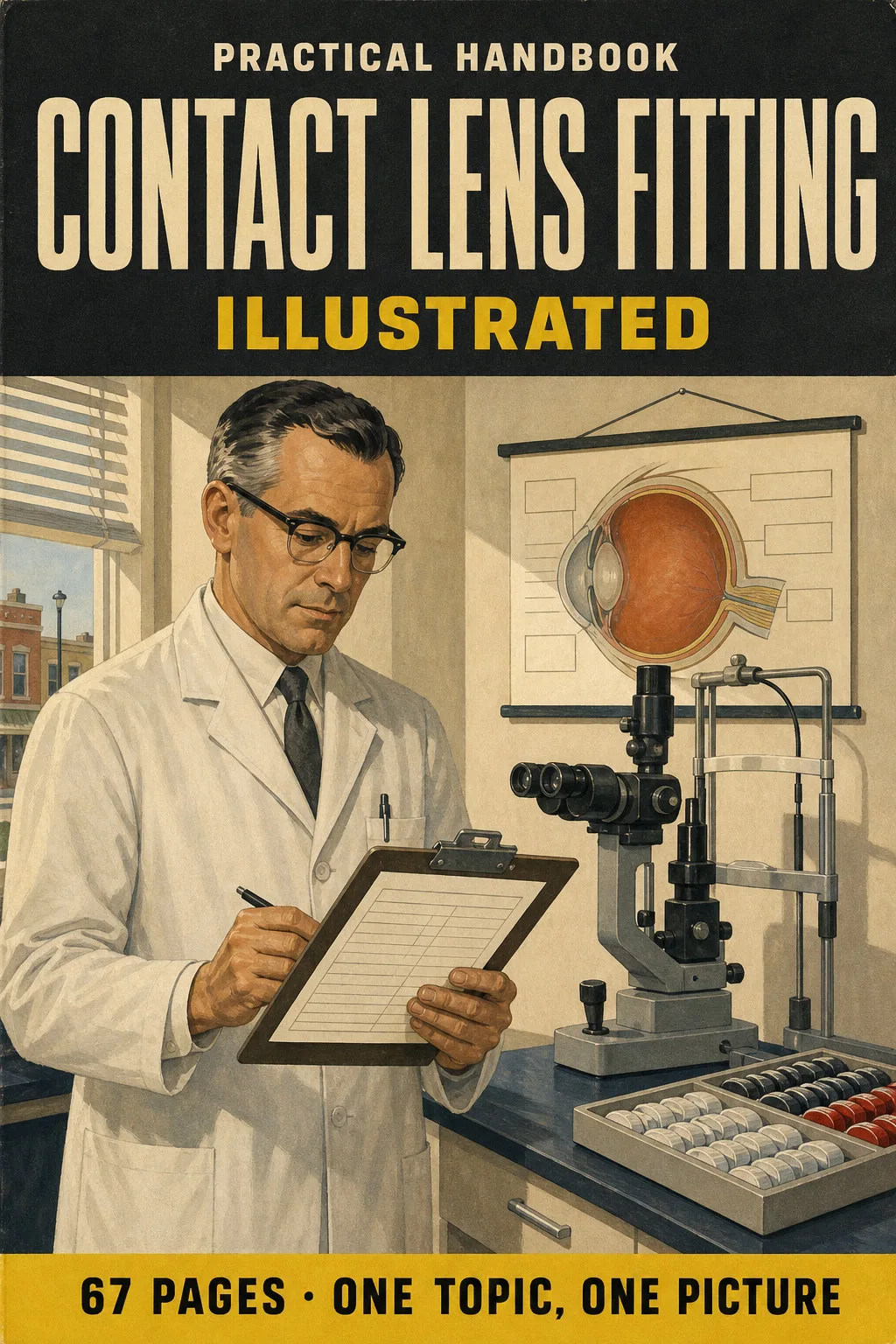
Contact Lens Fitting and the Basic Exam in Drawings Vertex, Torics and the Fit, Always in the Same Order

For opticians preparing for the US basic contact lens exam: keratometry, vertex conversion, toric axis and LARS, fit assessment, fluorescein patterns, lens care and when to refer. Every topic has its own page: the drawing first, then what you need to remember. 67 illustrated pages.

START STUDYING THIS WAY

🔒 Secure checkout · PDF by email · 30-day guarantee

Every topic, its own pageEvery fit and every formula drawn, with the explanation right beside it
67 illustrated pages9 parts, from the front of the eye to the exam-day checklist
Up-to-date sourcesNCLE exam outline, FDA guidance and the FTC Contact Lens Rule
PDF by emailFormat

Look Inside the Book

Every page has one big drawing and a box with the numbers and steps you need to know:

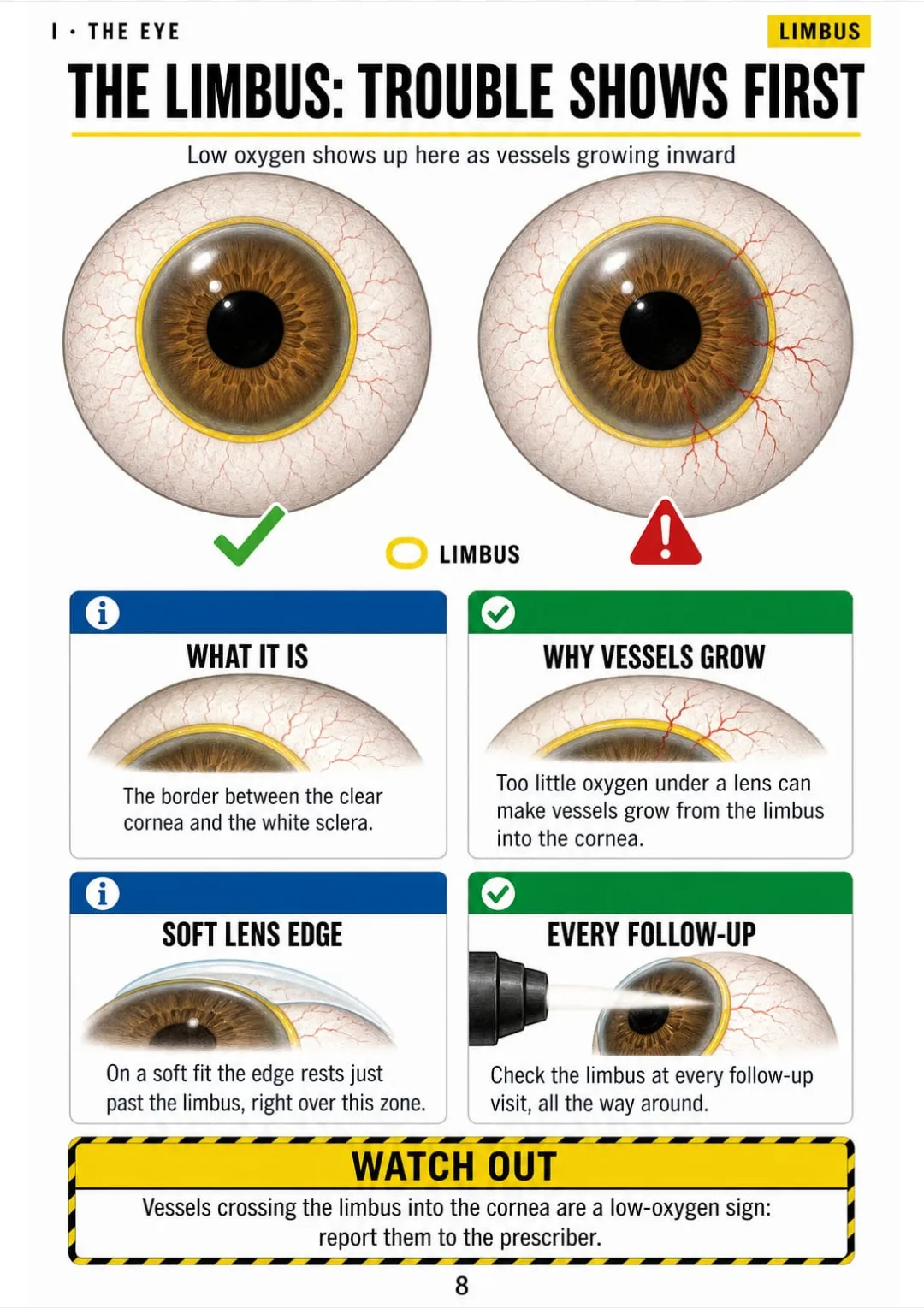
Vessels crossing the limbus into the cornea: the early sign of too little oxygen.
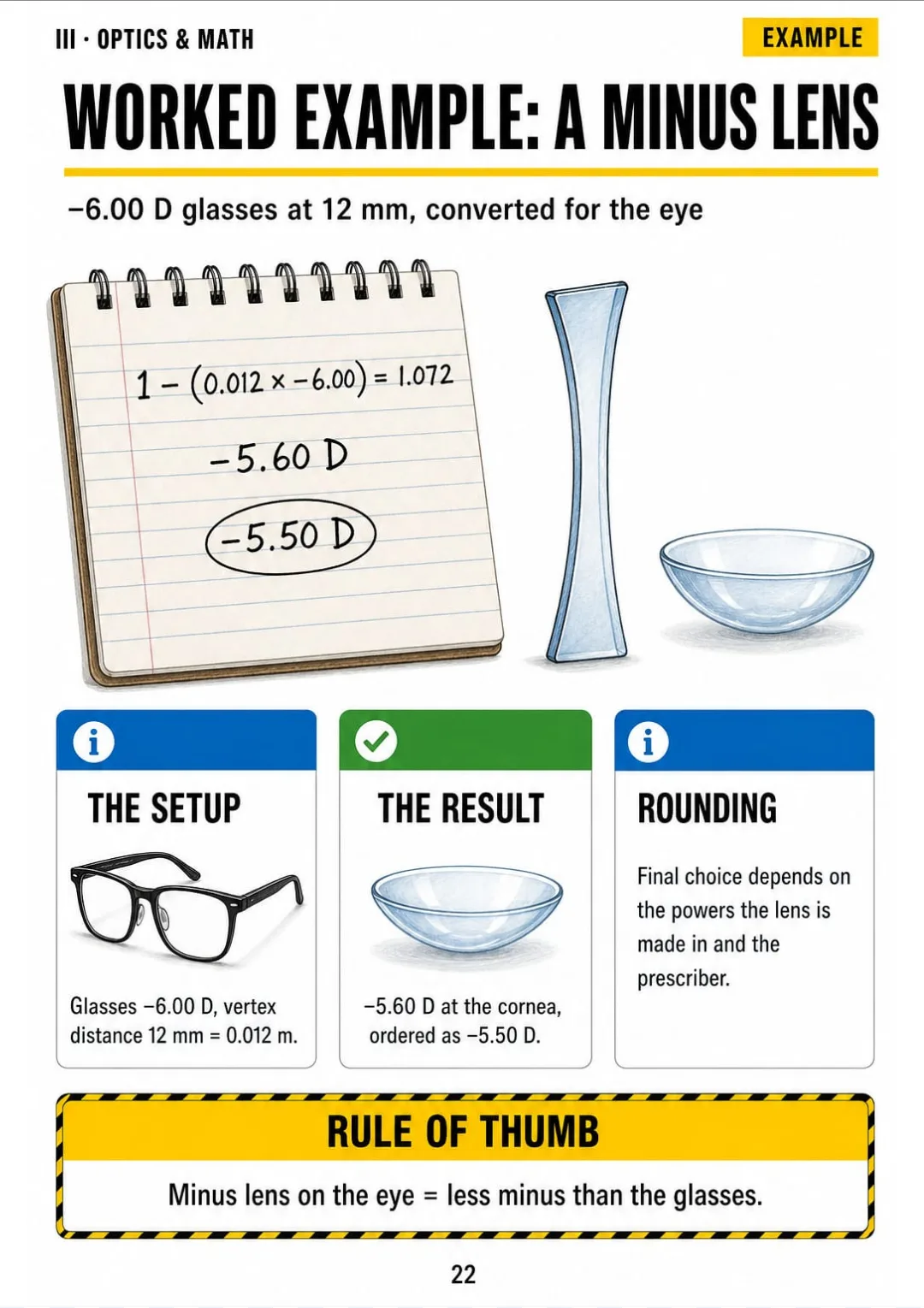
−6.00 D at 12 mm → −5.60 D → ordered as −5.50 D.
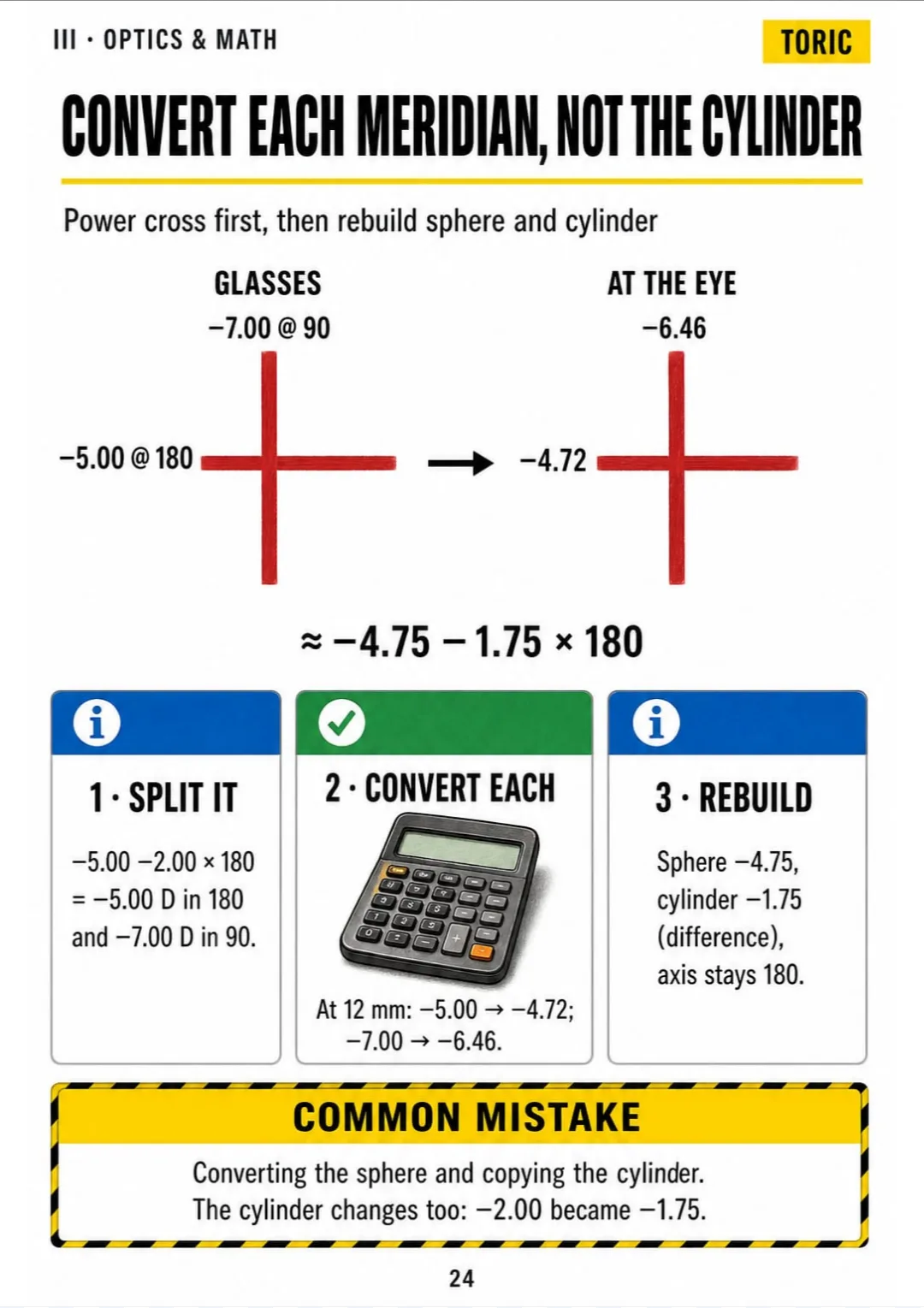
−5.00 −2.00 × 180 at 12 mm ≈ −4.75 −1.75 × 180.
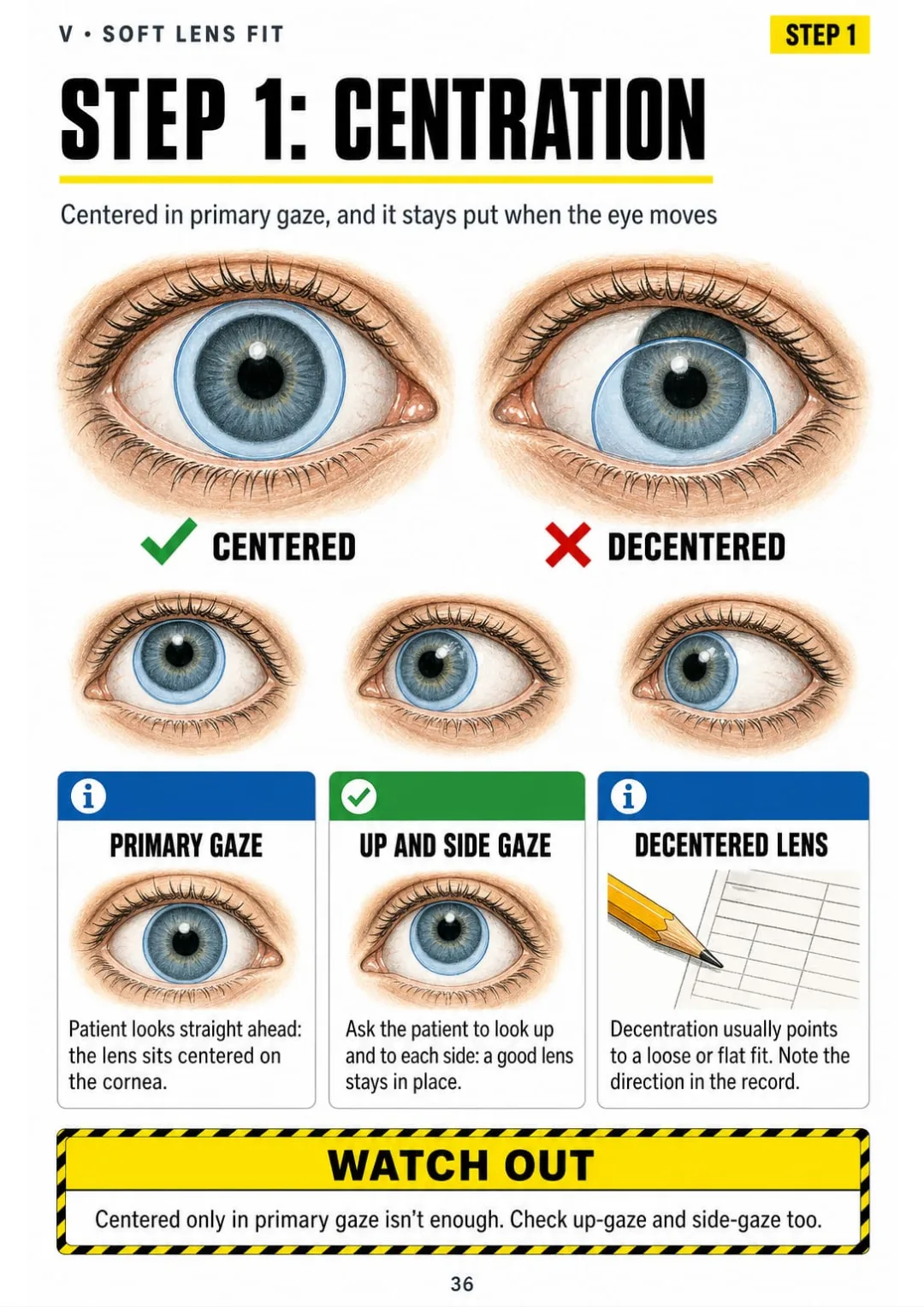
Centration: centered in primary gaze and stable in up- and side-gaze; decentration usually means loose or flat.
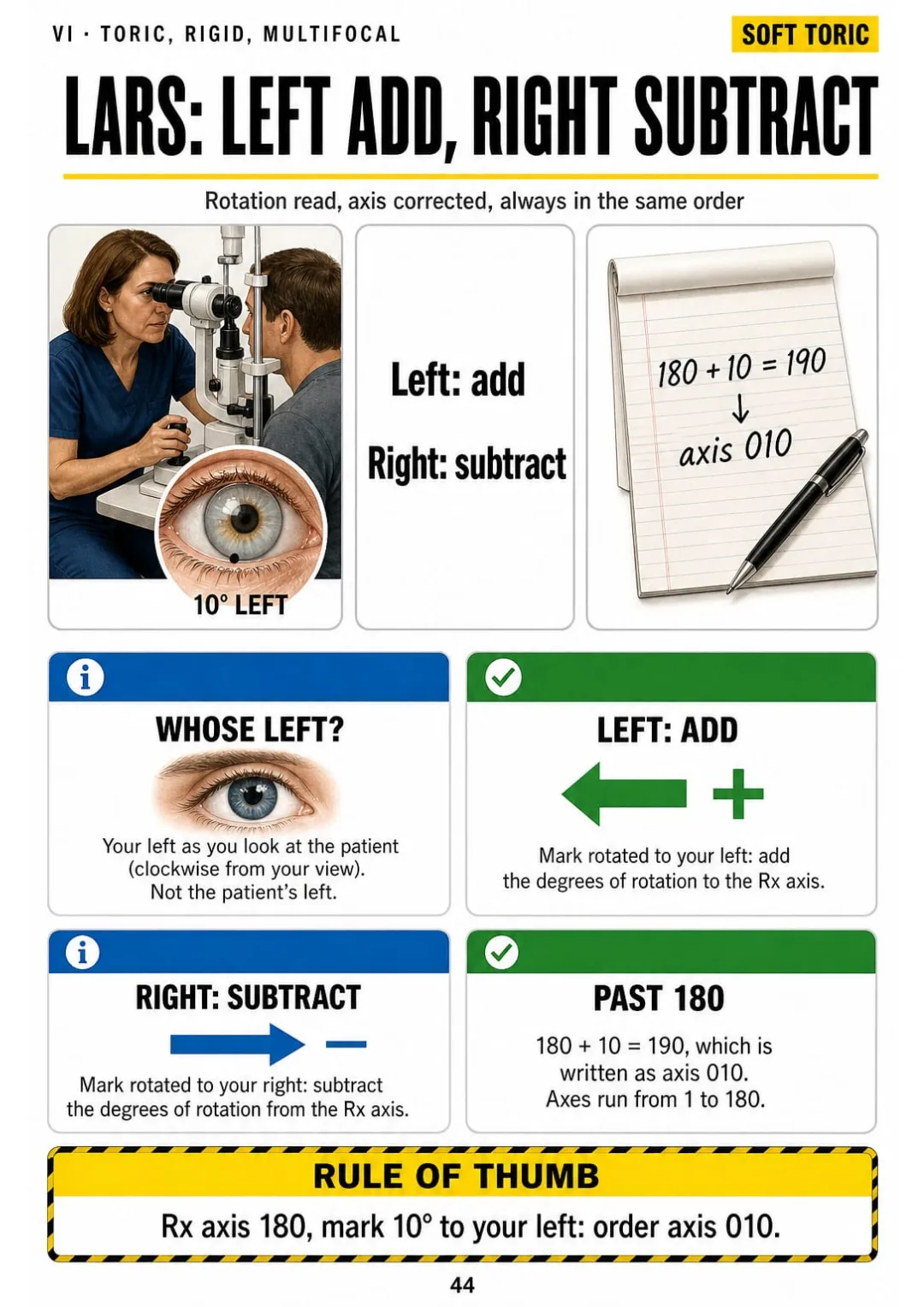
LARS worked example: axis 180, mark 10° left → order axis 010
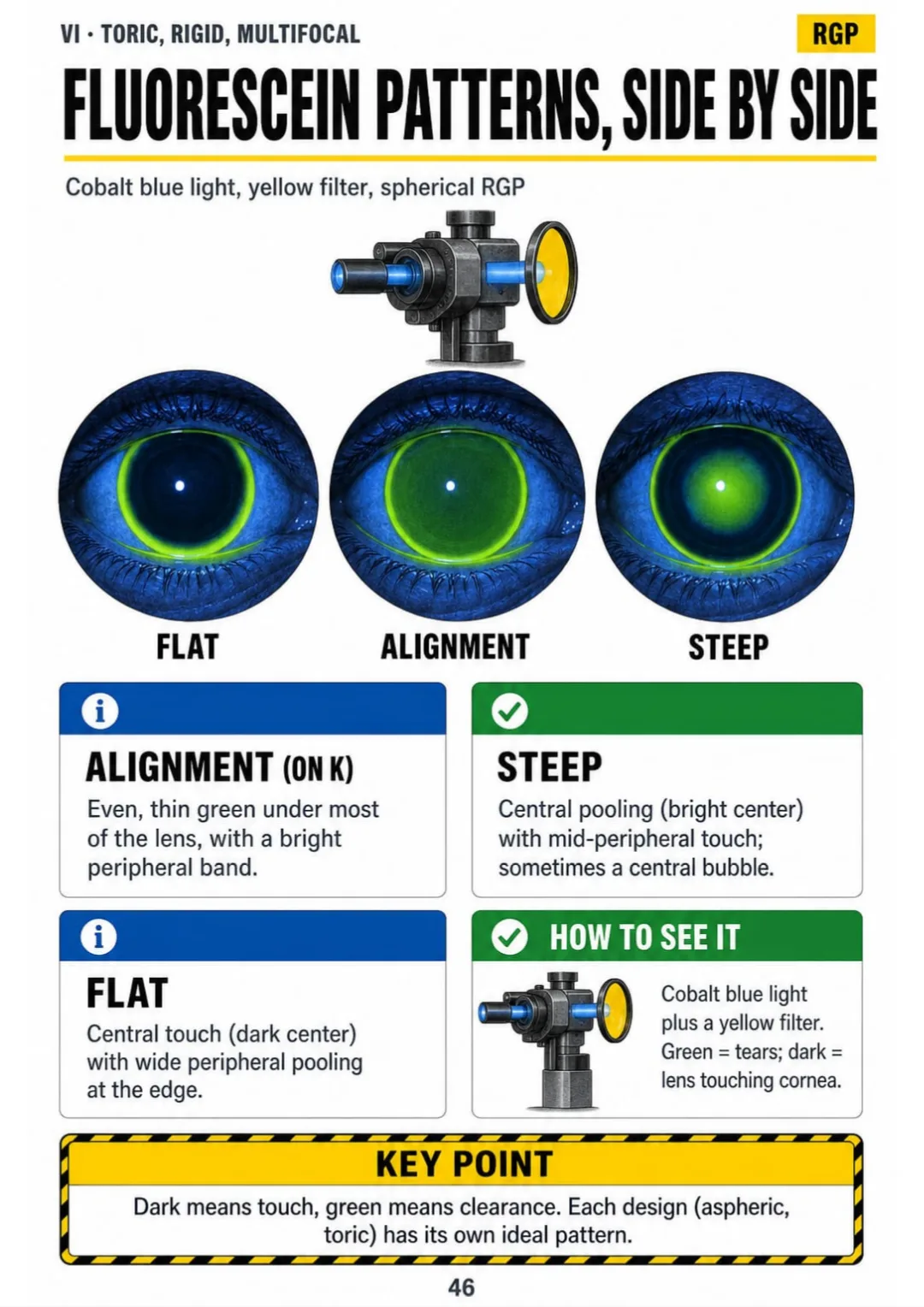
Flat, alignment, steep: three fluorescein patterns drawn side by side
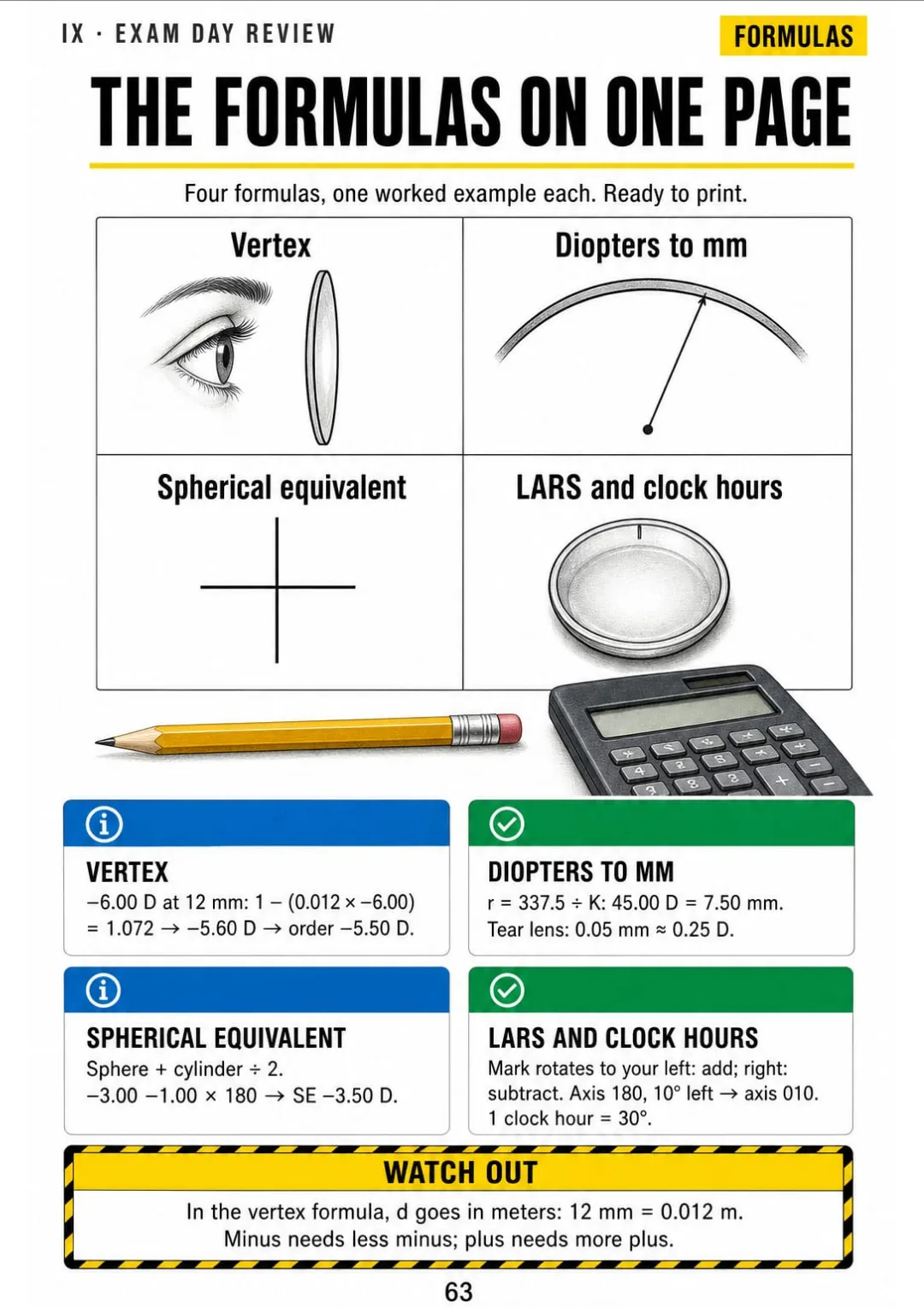
Vertex, K to mm, spherical equivalent and LARS: four formulas, four worked examples.
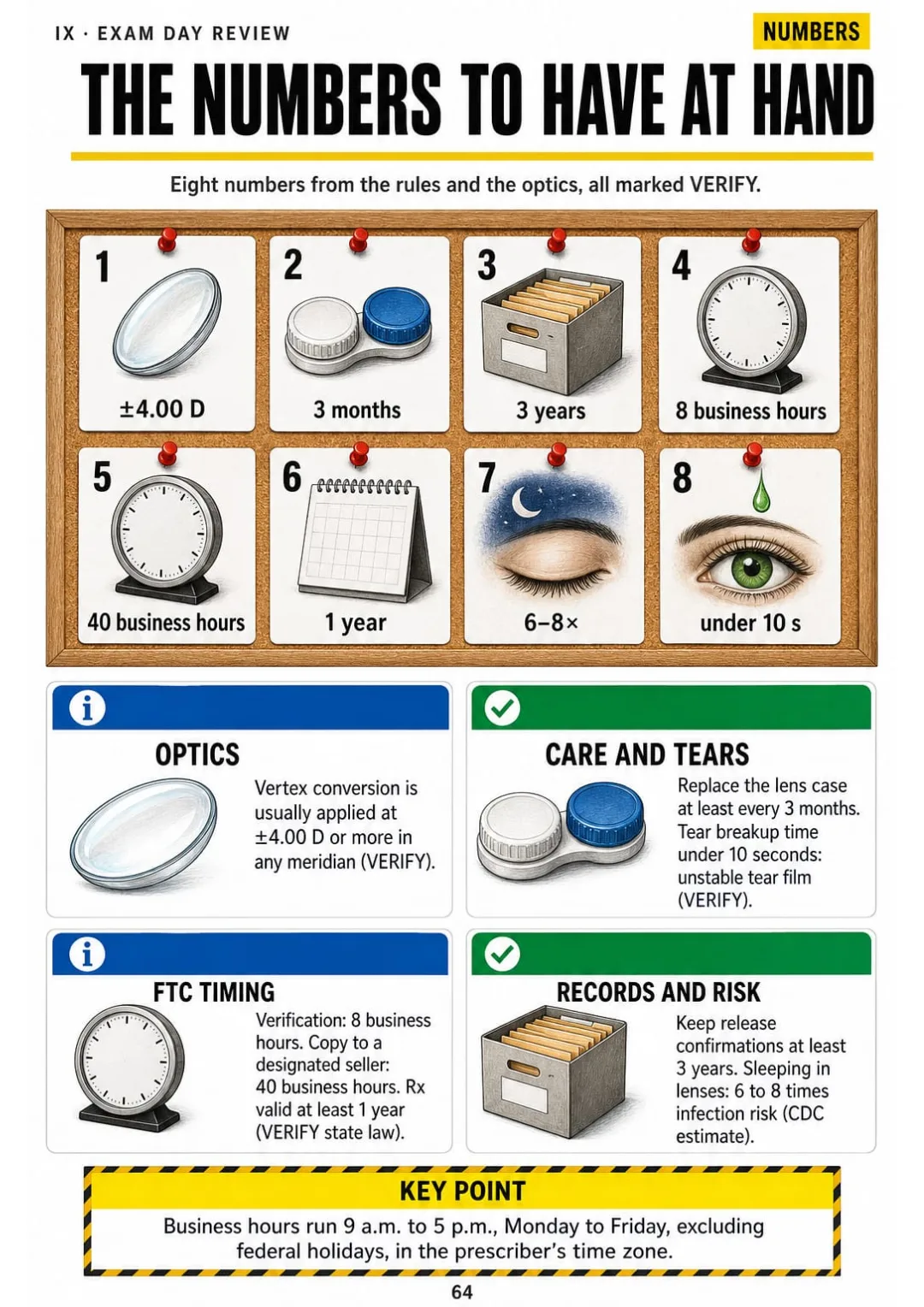
±4.00 D, 3 months, 3 years, 8 and 40 business hours: the numbers on one card.

Swipe to see more →

These are real pages from the book. The table of contents is the full one: 9 parts and 63 topics.

The Problem Isn't You. It's How It Was Explained to You.

You're at the fitting station with a glasses Rx of −5.00 −2.00 × 180 at 12 mm, and the doctor wants the contact lens power before the patient leaves the chair.

You know the vertex formula. But the manual covers toric conversion in three dense paragraphs and never tells you plainly: convert each meridian, not the cylinder. So you run the cylinder through the formula, and the number comes out wrong.

−5.00 −2.00 × 180 at 12 mm ≈ −4.75 −1.75 × 180.

In the book it's one page: the power cross drawn with −5.00 on one meridian and −7.00 on the other, each one converted, then subtracted. −4.75 −1.75 × 180, worked out in front of you.

The same goes for the push-up test, LARS for toric rotation, fluorescein patterns in RGP lenses and the numbers in the FTC Contact Lens Rule: each one has its own page.

You see the steps, you see why, and you do the conversion without going back to the manual.

COMPARE FOR YOURSELF

The Same Topic, Two Ways to Study It

THIS
  • The manual: line after line after line
  • Vertex conversion explained only in words
  • You walk into the exam still unsure
When the refractive correction exceeds approximately ±4.00 diopters, the effective power of the lens at the corneal plane must be determined, since the spectacle lens is positioned at a given vertex distance from the eye. The effective power is obtained by means of the expression Fc = F / (1 − dF), in which d represents the vertex distance expressed in meters. For a spectacle prescription of −6.00 D at a vertex distance of 12 mm, the resulting value of approximately −5.60 D is subsequently rounded to the nearest available power, −5.50 D.
FOR THIS
  • Vertex conversion in one drawing
  • The 3 steps in one box
  • You see it, and you get it
−6.00 D at 12 mm → −5.60 D → ordered as −5.50 D.
CONTENTS

Take a Look at the 9 Parts and 63 Topics

The eye, measuring, the optics and the math, materials and designs, soft lens fitting, toric, rigid and multifocal, care and complications, the Rx and the rules, and exam-day review: 67 pages, all illustrated

IThe eye a lens sits on · pp. 5-11
  1. The front of the eye in one drawing
  2. The cornea's 5 layers
  3. Why the cornea needs air
  4. The limbus: where trouble shows first
  5. The tear film's 3 layers
  6. Lids and blinking
  7. The conjunctiva and what the lid hides
IIMeasuring before you fit · pp. 12-18
  1. Keratometry: what K means
  2. Reading a K: a worked example
  3. Diopters to millimeters and back
  4. With-the-rule, against-the-rule, oblique
  5. Corneal astigmatism vs refractive astigmatism
  6. HVID, pupil and lid aperture
  7. Tear assessment before the fit
IIIThe optics and the math · pp. 19-26
  1. Why the glasses Rx changes on the eye
  2. When to convert: the ±4.00 D rule
  3. Vertex conversion in 3 steps
  4. Worked example: a minus lens
  5. Worked example: a plus lens
  6. Convert each meridian, not the cylinder
  7. Spherical equivalent
  8. Over-refraction
IVLenses: materials and designs · pp. 27-33
  1. Soft vs rigid gas permeable at a glance
  2. Hydrogel vs silicone hydrogel
  3. Dk and Dk/t
  4. The FDA groups for soft lenses
  5. Lens parameters: what each number means
  6. Wear schedule vs replacement schedule
  7. Special lenses: an overview
VFitting soft lenses · pp. 34-41
  1. Choosing the first trial lens
  2. Fit assessment: always in the same order
  3. Step 1: centration
  4. Step 2: coverage
  5. Step 3: movement and the push-up test
  6. Tight, good, loose: side by side
  7. Fixing the fit: which way to change
  8. Slit lamp illumination for the fit
VIToric, rigid and multifocal · pp. 42-49
  1. How a soft toric lens stays put
  2. Reading rotation from the marks
  3. LARS: Left Add, Right Subtract
  4. RGP: on K, steeper or flatter than K
  5. Fluorescein patterns in RGP lenses
  6. RGP position and movement
  7. Presbyopia: monovision vs multifocal
  8. Keratoconus and irregular corneas
VIICare, complications and when to refer · pp. 50-57
  1. Teaching insertion and removal
  2. Multipurpose vs hydrogen peroxide
  3. The water rule and the case rule
  4. Sleeping in lenses: the risk in one page
  5. What you see → when to refer: the urgent ones
  6. What you see → when to refer: the routine ones
  7. CLARE and infiltrates
  8. Deposits and lens damage
VIIIThe Rx, the rules and dispensing · pp. 58-62
  1. What a contact lens Rx must include
  2. The FTC Contact Lens Rule in 4 cards
  3. Glasses Rx vs contact lens Rx
  4. Dispensing visit checklist
  5. Follow-up schedule and records
IXReview for exam day · pp. 63-67
  1. The formulas on one page
  2. The numbers to have at hand
  3. Pairs that get mixed up
  4. What the basic exam outline covers
  5. Final checklist: the fit in 3 steps, the math in 3 steps

One Page, One Topic, All Clear

Think of it this way:

A patient is in the chair with a new soft lens, and the doctor asks you how it's moving. You have a couple of blinks to look.

You've already seen the push-up test drawn in the book: a good lens moves freely and recenters promptly, a tight one barely moves. So you know exactly what you're looking for.

LARS worked example: axis 180, mark 10° left → order axis 010

The same with vertex conversion, reading a K, LARS for torics, fluorescein patterns and what you see before you refer: each one on its own page.

Contact Lens Fitting Illustrated is 9 parts and 63 topics, all drawn, and it ends with the formulas on one page, the numbers on one card and a final checklist.

What you see drawn, you don't have to memorize.

What's Inside Contact Lens Fitting Illustrated:

Ipp. 5-11

The eye a lens sits on

The front of the eye in one drawing, the cornea's 5 layers, why it needs air, the limbus, the tear film, lids and blinking, the conjunctiva.

IIpp. 12-18

Measuring before you fit

What K means, a K read step by step, diopters to millimeters, with-the-rule and against-the-rule, corneal vs refractive astigmatism, HVID and tear assessment.

IIIpp. 19-26

The optics and the math

So the glasses Rx turns into the lens you order: why it changes on the eye, the ±4.00 D rule, vertex in 3 steps, a minus and a plus example, each meridian converted, spherical equivalent, over-refraction.

IVpp. 27-33

Lenses: materials and designs

Soft vs RGP, hydrogel vs silicone hydrogel, Dk and Dk/t, the FDA soft lens groups, what each parameter means, wear vs replacement schedule.

Vpp. 34-41

Fitting soft lenses

The first trial lens, the fit always in the same order: centration, coverage, movement and push-up, tight, good and loose side by side, fixing the fit, slit lamp.

VIpp. 42-49

Toric, rigid and multifocal

So you call the axis and read the pattern without guessing: how a soft toric stays put, reading rotation, LARS, RGP on K, steeper or flatter, fluorescein patterns, monovision vs multifocal, keratoconus.

VIIpp. 50-57

Care, complications and when to refer

Insertion and removal, multipurpose vs peroxide, the water and case rules, sleeping in lenses, what you see and when to refer, CLARE, deposits.

VIIIpp. 58-62

The Rx, the rules and dispensing

What a contact lens Rx must include, the FTC Contact Lens Rule in 4 cards, glasses Rx vs contact lens Rx, the dispensing checklist, follow-ups and records.

IXpp. 63-67

Review for exam day

The formulas on one page, the numbers to have at hand, pairs that get mixed up, what the basic exam outline covers, the final checklist.

At the end of the book: The formulas on one page, the numbers on one card and a final exam-day checklist.
Plus: 2 Free Books

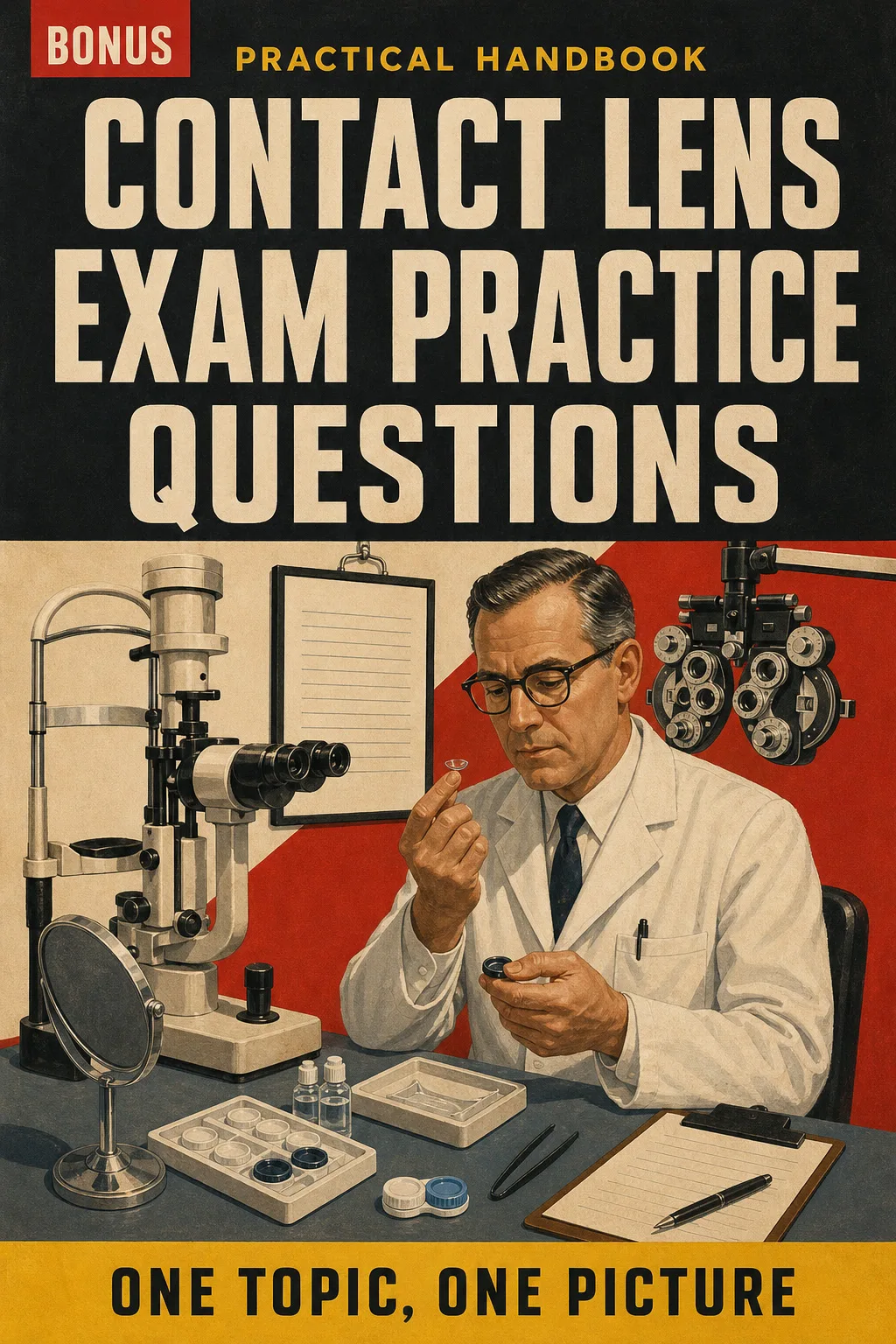
Contact Lens Exam Practice Questions

BONUS 1: «Contact Lens Exam Practice Questions»

Value on its own: US$ 17.90

Exam-style questions with the answer explained on the same page, so you find out what you really know before exam day.

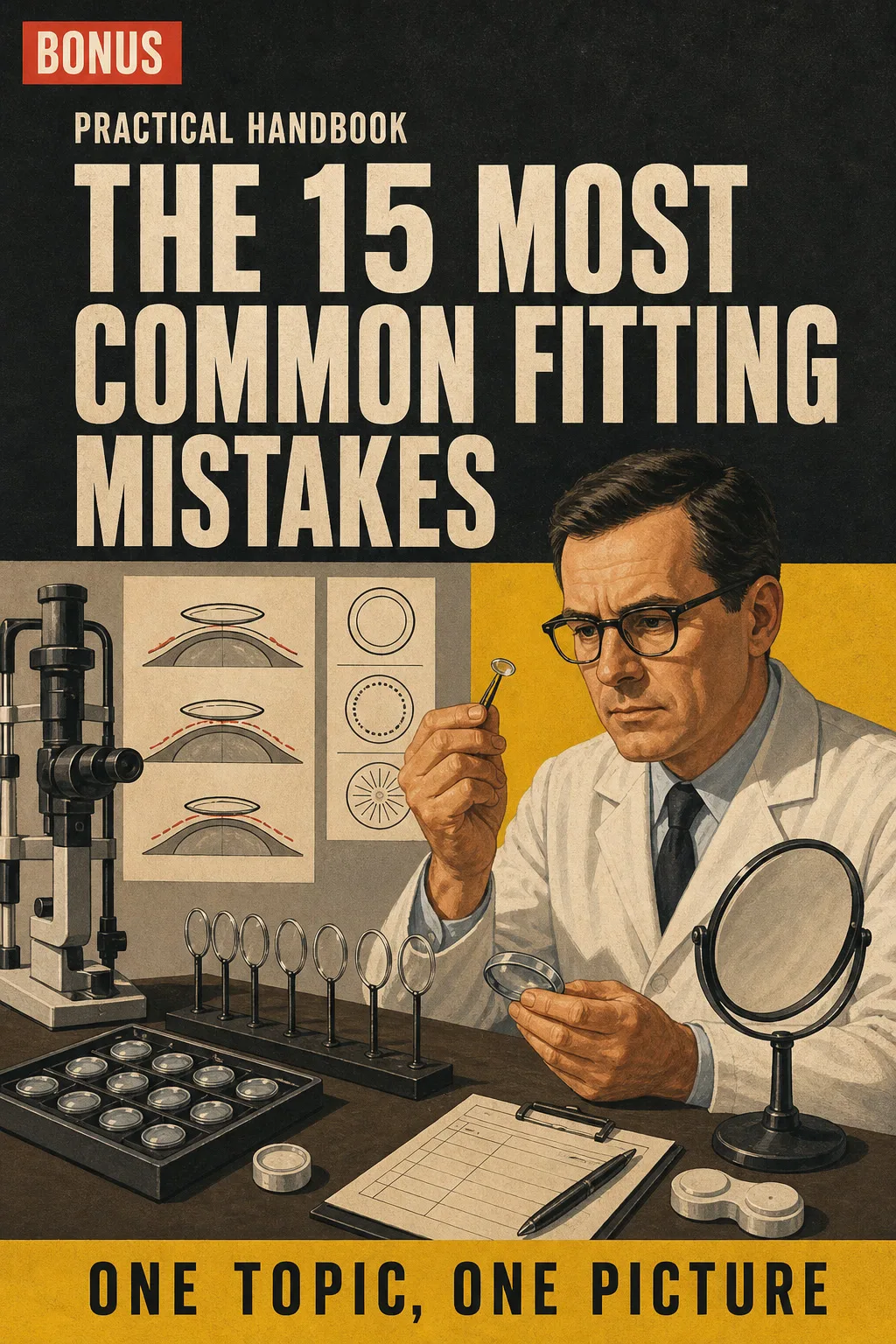
The 15 Most Common Fitting Mistakes

BONUS 2: «The 15 Most Common Fitting Mistakes»

Value on its own: US$ 14.90

The mistakes opticians make most often, drawn before and after, so you can review them at a glance on a break.

Black Friday week · ends Nov 30

Contact Lens Fitting Illustrated with 2 Free Books

  • Contact Lens Fitting Illustrated: 67 illustrated pagesUS$ 63
  • BONUS 1: Contact Lens Exam Practice QuestionsUS$ 17.90
  • BONUS 2: The 15 Most Common Fitting MistakesUS$ 14.90
  • High-resolution PDF to printIncluded
Total value US$ 95.80
BLACK FRIDAY PRICE:
US$ 27
You save US$ 68.80
YES, I WANT CONTACT LENS FITTING ILLUSTRATED FOR US$ 27

📄 This is a digital PDF book sent to your email: nothing is printed or shipped.

Secure purchaseEncrypted payment30-day guarantee

PDF by email: We email you Contact Lens Fitting Illustrated as a PDF, together with the two free books. It's a single payment: no installments, no extra charges.

Who This Book Is For

You're studying contact lenses

You're studying contact lenses

Each topic is one page with one drawing, so a lunch break is enough to get through keratometry or vertex without losing the thread.

Your exam date is set

Your exam date is set

The formulas on one page, the numbers on one card and a practice book with the answers explained, to review everything in the same order.

You already fit lenses with the doctor

You already fit lenses with the doctor

The fit in 3 steps, LARS and when to refer, printed and kept at the fitting station for when the doctor asks.

Everything You Get Today

US$ 95.80US$ 27
YES, I WANT CONTACT LENS FITTING ILLUSTRATED FOR US$ 27

📄 This is a digital PDF book sent to your email: nothing is printed or shipped.

30DAYS
GUARANTEE

30-Day Guarantee

Try Contact Lens Fitting Illustrated for 30 days, bonus books included.

We refund everything if the file won't open, if the book isn't what you see here, if you were charged twice or if the email doesn't arrive. Just email us.

You pay once. No subscriptions.

Frequently Asked Questions

Is it for me if I've dispensed glasses for years and I'm adding contact lenses?

Yes. It doesn't re-teach glasses dispensing: it starts from the eye a lens sits on and goes up to vertex math, torics, RGP and the contact lens Rx rules. If you already know some of it, the drawings make the review fast. It follows the published outline of the national basic contact lens exam. If your state licenses contact lens dispensing, check with your board which exam it requires; a state law or jurisprudence exam isn't covered.

Where does the content come from?

From the published content outline of the basic contact lens exam, the ANSI contact lens standard, FDA contact lens guidance and the FTC Contact Lens Rule. Every number and rule is checked against the current version.

Is this official material?

No. It's independent study material, not affiliated with or endorsed by any exam board, agency or association. It doesn't come with a certificate or continuing education credits.

Does it replace my course or training?

No. It's a study aid. It doesn't replace formal training, supervised practice or the judgment of the optometrist or ophthalmologist.

Are the practice questions the ones on the exam?

No. They're written for this book, in exam style, with the answer explained. They aren't official questions from any exam.

When and how do I get it?

As a PDF by email, at the address you enter at checkout: the book and the 2 bonus books.

Do I have to pay every month?

No. It's a one-time payment. No subscription.

Can I have it on paper?

Yes. The PDF is made to print, at home or at a print shop, and keep at the fitting station.

How does the refund work?

You have 30 days. We refund everything if the file won't open, if the book isn't what you see on this page, if you were charged twice or if the email doesn't arrive: just email us.

Before You Close This Page

No more rereading a chapter and keeping nothing.

The push-up test, LARS and vertex: you see them drawn, and that's it.

You walk into the exam knowing where everything is.

Drawings make studying faster.

The book is right below.

One-time payment: US$ 27 · Guarantee: 30 days · PDF by email

YES, I WANT CONTACT LENS FITTING ILLUSTRATED FOR US$ 27

📄 This is a digital PDF book sent to your email: nothing is printed or shipped.